Recently playing soccer, I came across someone’s tattoo on their leg. It wasn’t an inscription of some cool symbols or beautiful picture. Instead it was a QR code. A plain QR code that we see on Wechat or Alipay was neatly transplanted into his skin. It was clean and crisp.
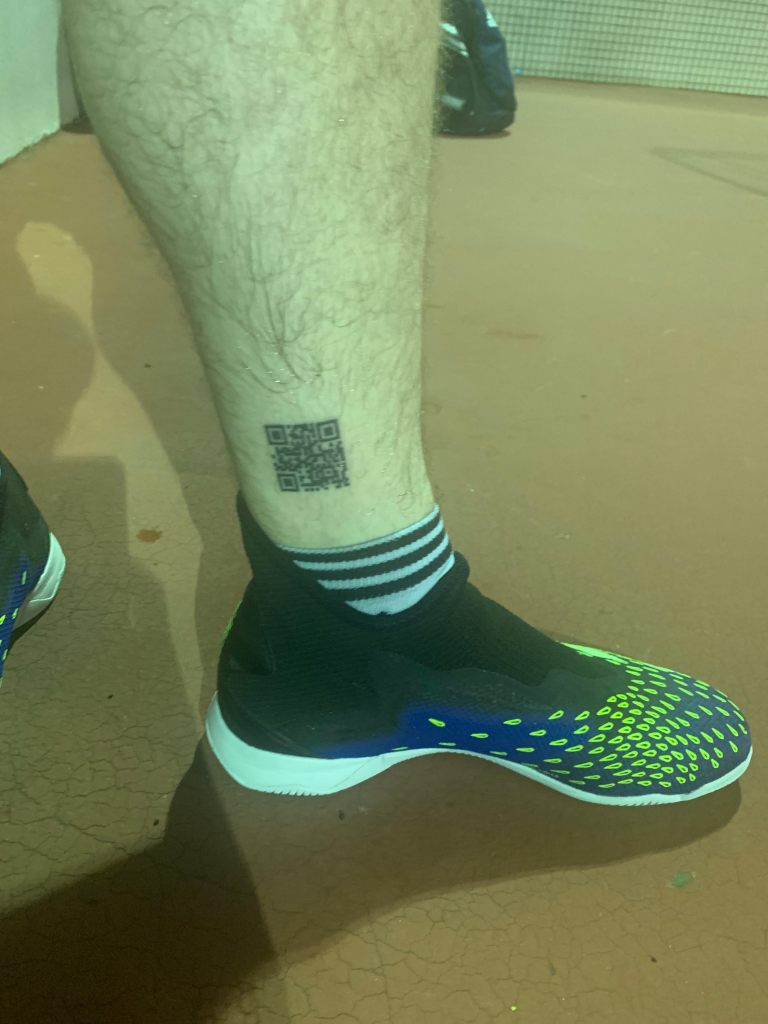
I asked whether it was scannable. He said it was. When I scanned it, it directed to a Google Search result with a combination of some numbers and initials like “2020SHP”. He said that it’s related to his family. (I tried re-scanning the photo, but it didn’t work. You can try yourself too but don’t magnify too much or you will see some sweaty leg hairs)
My mind started to burst with imagination. I thought it was absolutely brilliant and futuristic. Here was a clear, physical link to a digital world. It wasn’t just a bridge to some digital address. This bridge was permanently etched to oneself in a way that it becomes fully mobile and uniquely oneself’s. In a way where oneself can uniquely own and carry oneself, this etched bridge will be uniquely his or hers, and on the extension, the digital destination / information that this link point can also be uniquely oneself’s.
For instance, I can have my website (sanghapark.com, one example of your digital presence) that’s (only) accessible through my QR code tattoo. In short, my physical presence is directly linked to my digital presence.1
Imagine all the fascinating possibilities of owning such bridge would mean. First it would suggest that I now can have a dual presence in both the physical and digital world (through the bridge). So much of our digital presence has been focused on creating a siloed social profile or jumble of unconscious activities (ex: likes, clicks, scrolls, comments) that are not purposeful and conscientiously designed by ourselves.
Just like how we have the full autonomy to decide how we dress and hence project our physical identity, we should have the full independence and power to decide how we want to express ourselves in digital reality as well.
This leads to bigger concept of sovereign digital identity. Currently we do not automatically own any digital identity or presence. No digital identity is created when we are born. Rather parts of our digital identity is created whenever we join digital platforms like Facebook or use digital services like Google or use digital devices like iPhone. If we recognize that access to cyberspace is a public good and one of basic human rights, such fragmented ownership of one’s digital identity by companies quickly start to make little sense.2 If we were to re-design and re-start how every one of us becomes a digital citizen, it should be something along the lines of everyone owning their digital identity that’s created when they are born and uniquely belongs to them. Then each individual should be able to control how they use their identity in various digital services.
The idea of sovereign individual would naturally lead to decentralized networks like Ethereum that can power such concept, but we will keep that for future discussions.
Finally once we have our digital selves that can be fully controlled by us, we can also have our digital selves to exist even after our physical selves perish. In short, our digital selves can be “immortal”. Our digital selves can be static or even be dynamic in a way that’s responsive based on latest AI technology. For instance, once we die, we can transfer all our physical and siloed “data” to our digital self to be trained with latest AI technology to now replace the physical self. I don’t know if we can ever transfer conscience or self-awareness or our own memories digitally, but simulation of our physical self itself would be enough of a world changing prospect. I like to think this is a Digital Funeral, which I will talk about some other time as well.
However, soberingly, our digital self currently falls far short. We neither own our identities nor have the tools to aggregate, choose, and display our siloed data. Regulations like GDPR are pushing the world into the right direction, but it will be a long time or maybe never until we can fully own our digital identity. Ethereum addresses and personal websites that are self-hosted are probably the closest ones we have.
In 1979, JCR Licklider, one of visionaries in computer, wrote in The Computer Age:A Twenty-Year View that “self-motivating exhilaration” among users might connect and push networks to be a one broad interconnected public space (“Multinet”) rather than a siloed space independently managed by private companies and research institutions. More than 40 years have passed, and now everyone is virtually connected. We’ve come to a time where now that virtual network has trascended into a virtual space. Will there be another wave of “self-motivating exhilaration” to guide us? Can Ethereum be that wave? Or is there another alternative looming?
________________________________________________________________________________
- Balaji Srinivasan believes that digital space should be more pseudonymous rather than being outright transparent and being directly connected to your identity. I do believe that pseudonymity has a place, but I think everyone should also have their “public” digital presence
- Everyone’s now calling this space Metaverse as coined by Neal Stephenson

 Sang Ha Park
Leave a reply to Digital Being – Unabashed Public Practice Cancel reply