While we greatly praise Michelin-star restaurants and complaint about the ever-increasing default tips (now at 18% ), we pay very little attention to everyday places that we go to and how they are changing. Perhaps we assume that everything will stay the same: go in, order, get served, eat, pay, and leave. We only obsess over what we eat, not how we eat.
Visit Shanghai (and China more broadly), you’ll see just how much thought has gone into that how (and of course what as well). I’d argue the country now sits at the pinnacle of “restaurant as entertainment” and have created a very unique branch in evolution of everyday restaurants. For clarity, by “everyday restaurants,” I mean affordable spots anyone can walk into. Think Shake Shack, The Cheesecake Factory, and your local take‑out joint
01. Haidilao
If you enjoy Asian food, you probably know Haidilao, the famous hotpot franchise that will sing birthday songs, showcase fancy acrobatic moves to make noodles (they do this right in front of you, not behind their kitchens), and offer video games so that your wait is enjoyable. Back in 2018 when I went to Haidilao in Hong Kong for the first time, I was so thoroughly amazed that I begged my colleagues to take me every week. To me, Haidilao was the Hong Kong Disneyland. Yes, a lot of their showcases are instagrammable – visually striking and over-exaggerated. And you can argue that it’s all gimmicks. Sure, but gimmicks that consistently delight customers are rare.
What captured me were the little details: vinyl phone cases so that you can use your phone cleanly, arm protectors that block occasional pops from broth, and servers who radiate with smiles. It’s like an extremely well-made movie where everything is perfectly planned and adds up nicely to create a bigger whole. Gesamtkunstwerk.
My Hong Kong colleagues used to say, “Wait, you didn’t even visit mainland Haidilao stores, wait until you go there, they are so much better”. They were right. Fast‑forward seven years, that spark returned in Shanghai at two chains: Hěn Jiǔ Yǐ Qián Yáng Ròu Chuàn (很久以前羊肉串, “Once Upon a Time Lamb Skewers,” hereafter HJYQ) and Hóng Kuī Jiǎ (红盔甲, “Red Armor”). Both reignited the childlike awe I felt at Haidilao.
02. HJYQ
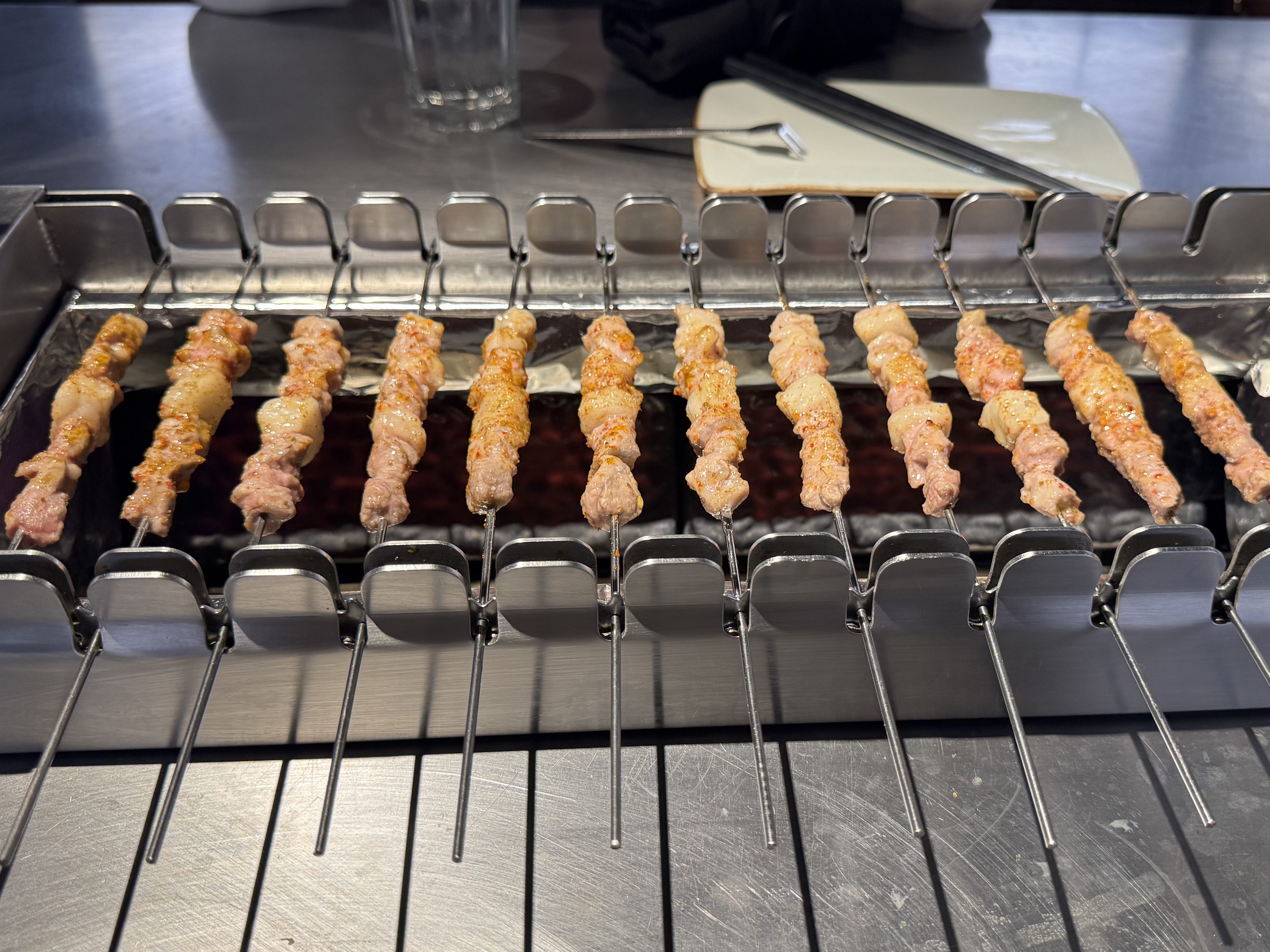

HJYQ sells lamb skewers, as the name suggests, and uniquely uses electric stoves, which are designed to dissipate much more heat. To make up for the heat, they give you chilled gel patches that you can paste on your forehead. Only then do you realize why everyone’s sporting the same forehead sticker and it feels like you’ve landed on a different planet.
Vinyl phone cases and aprons appear without request, which have become a standard customer service among Chinese restaurants. Then, you order through a QR code, the menu seems ordinary—lamb, intestines, and veggies—until you notice Lambhorginis and rockets. Turns out they refer to tips for servers. But belying their names, Lambos only cost 3.3 RMB, or 50 cents, and Rockets 9.9 RMB. Your mind goes back to 18% tip.
Meat arrives and your server scratches off your paper bill and types intensely on their phone. You like the redundancy. He skillfully lays the skewers down on the tray and presses the skewers that creates a crisp click. You like the efficiency and rhythm that it creates. But you just realize all the skewer handles are facing you and you think about whether to flip half of them to the other side for your partner. You decide to wait and give the benefit of doubt to the experts.
After several minutes, the server comes back, checks the meat, and lifts half of the skewers. Using the overhead rack, in a single wrist-flick, he flips six skewers into the opposite side. Having flipped so many skewers one by one, you find this extremely gratifying. You find grace in that perfected motion. You now fully believe that you are in good hands and let your guard down.
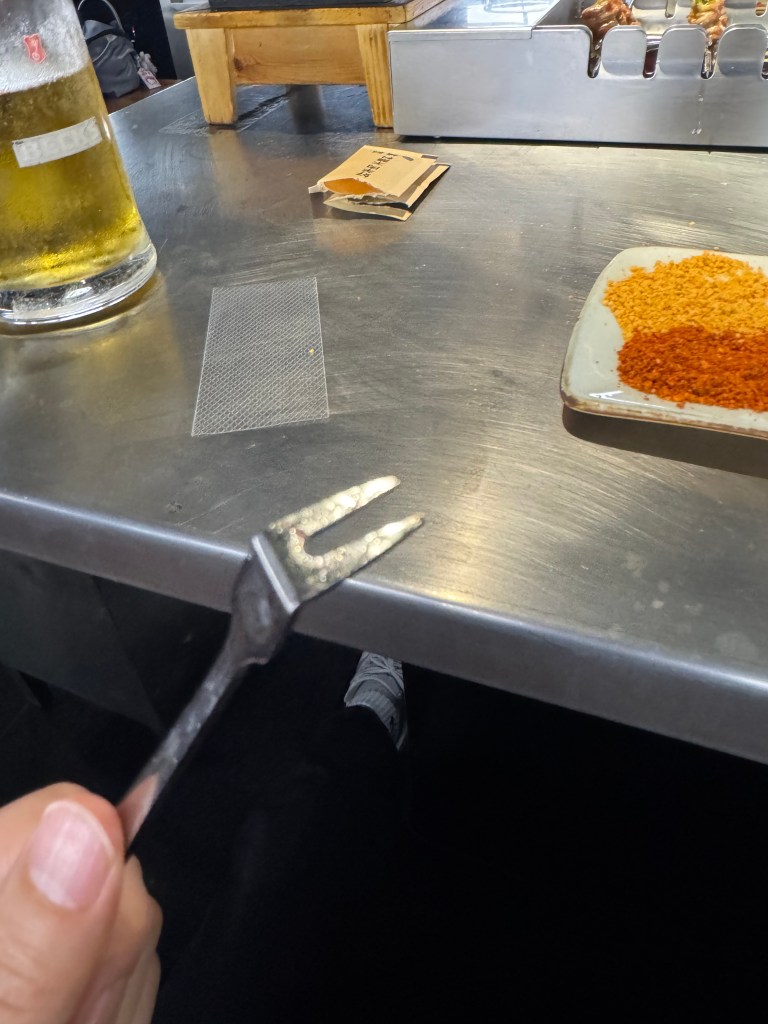
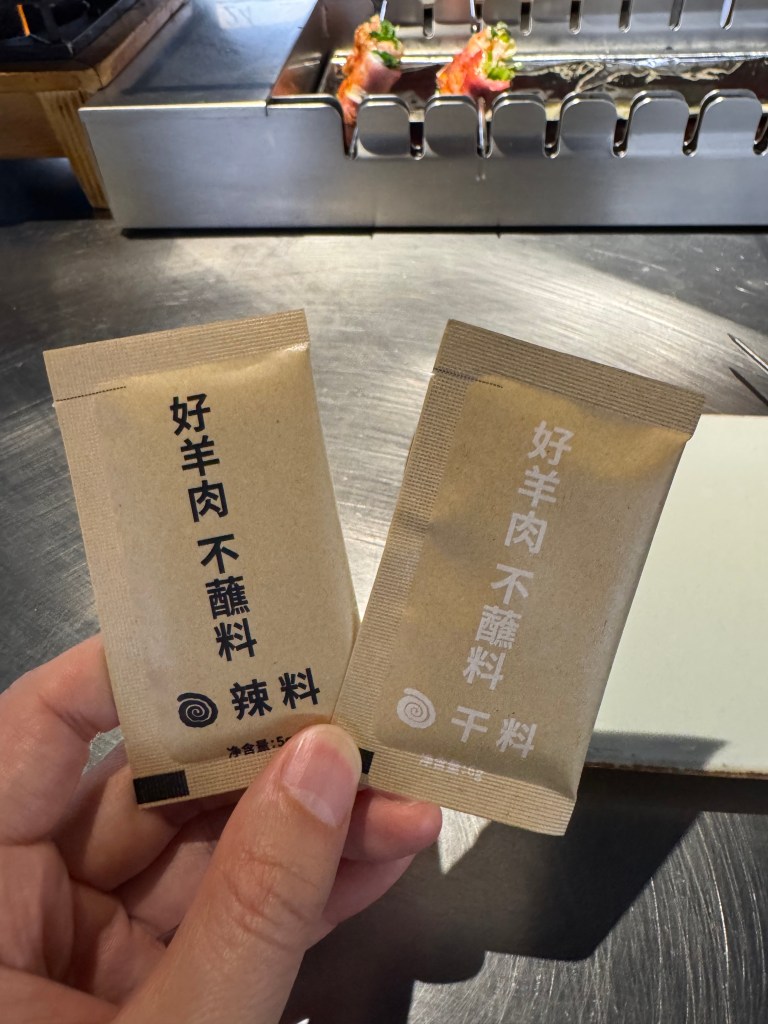
The meat is so soft that it melts. You are also given a special tool to pull out the leftover meat. No need to force it out with your chopsticks. A second server appears, chirps “서비스!”—Korean for “on the house”—and offers chilled cucumber to make up for the wait. They apologize for the long wait. Equally confused and dazed, you just nod your head. Perhaps there were lot of cucumber dishes left for the day, but it does feel great to be preemptively offered something and be recognized for the wait.
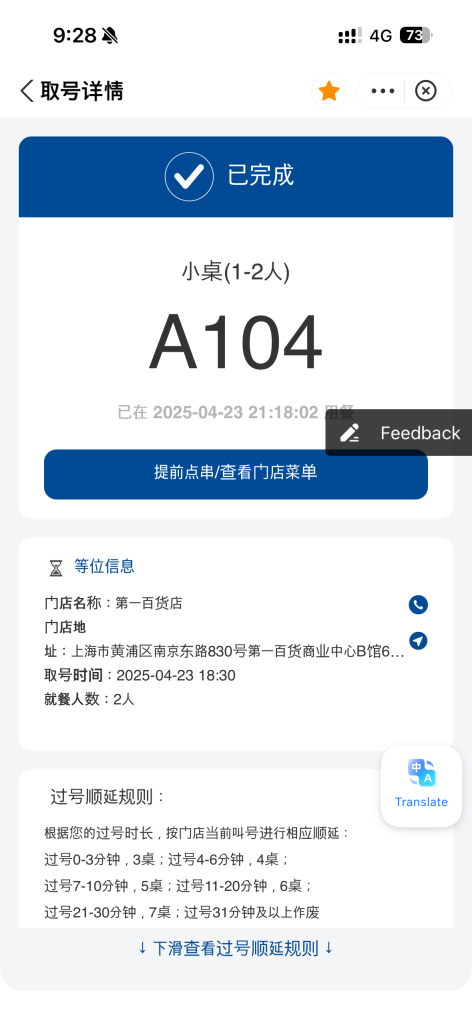
Oh yes, did you mention that you had to wait 3 hours to get in? Yet with the food, chill patch, and unsolicited cucumbers, the long wait seems more than worth it.
All the dishes were served. You also had a round of beer. There’s one bacon beef skewer laying on the rack, the server inspects it and says that it needs to go down again, “not ready.” At this point, you are completely sold. Instead of rockets, which are deceptively only priced at 9.9 RMB, you and your partner want to give the world and secretly tucks in 20 RMB to the server. You feel good.
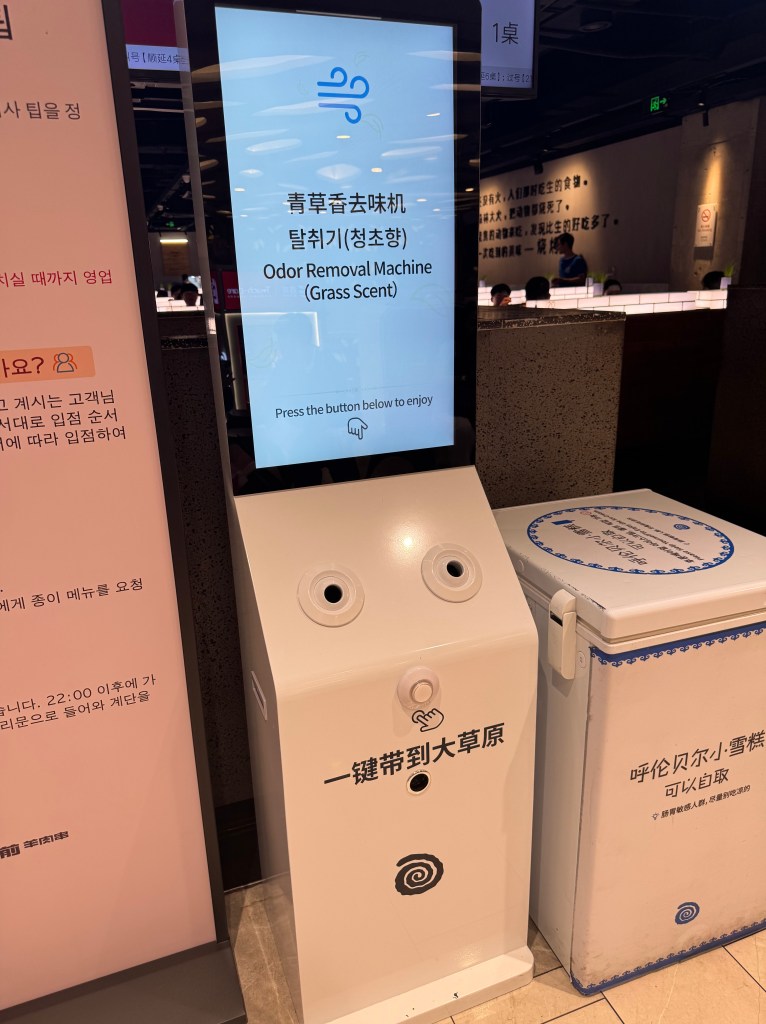
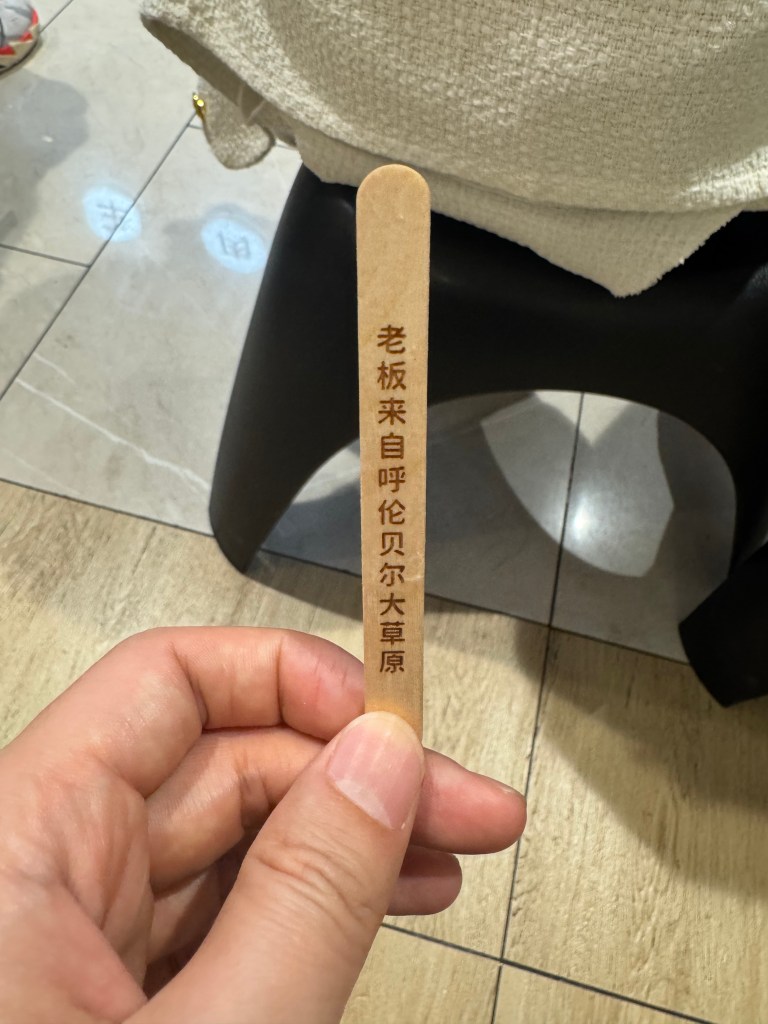
Stove is taken out and you can let your patches go. Your cheeks are still red and for the finale they hand you an ice cream. As you swim past rows of patched foreheads on your way out, a strange camaraderie settles in. The scent‑removal machine hums, but it does little to bring you back to Earth.
03. Red Armor
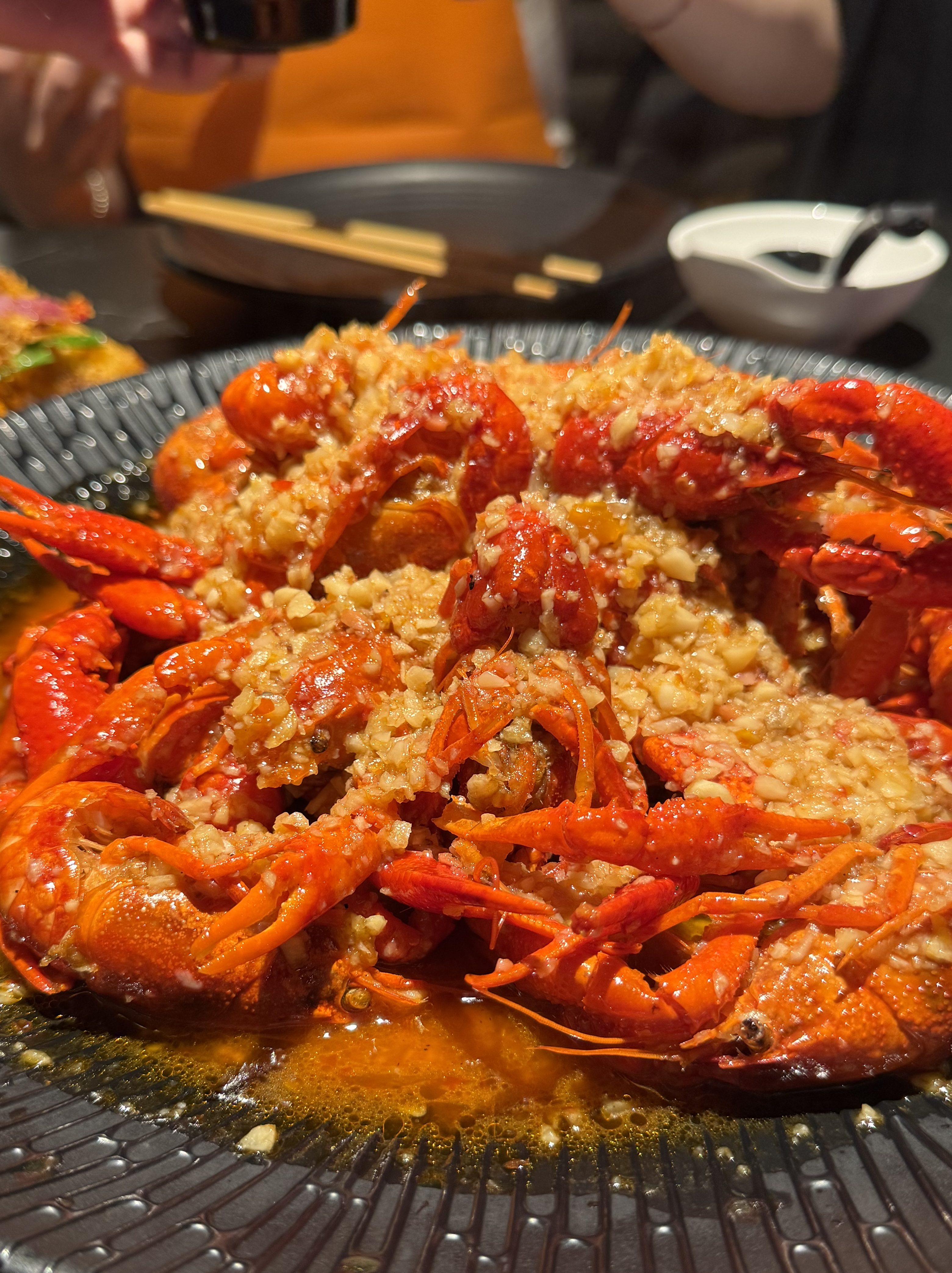
Red Armor sells crayfish (crawfish) marinated and stir fried with various Chinese sauces such as mala. The dish is more commonly known as 麻辣龙虾 (má là lóng xiā).
Having learned from 3 hour wait, you arrive around 4:30 in the afternoon. You expect no one, but several groups are already enjoying their feasts. Immediately you’re showered with attention and equipped necessary gadgets — vinyl gloves, disposable phone cases, and colorful red aprons. You see washing stand and wash your hands, and before you realize, one of the staff member sliently waits for you with paper towels. You’re flattered.
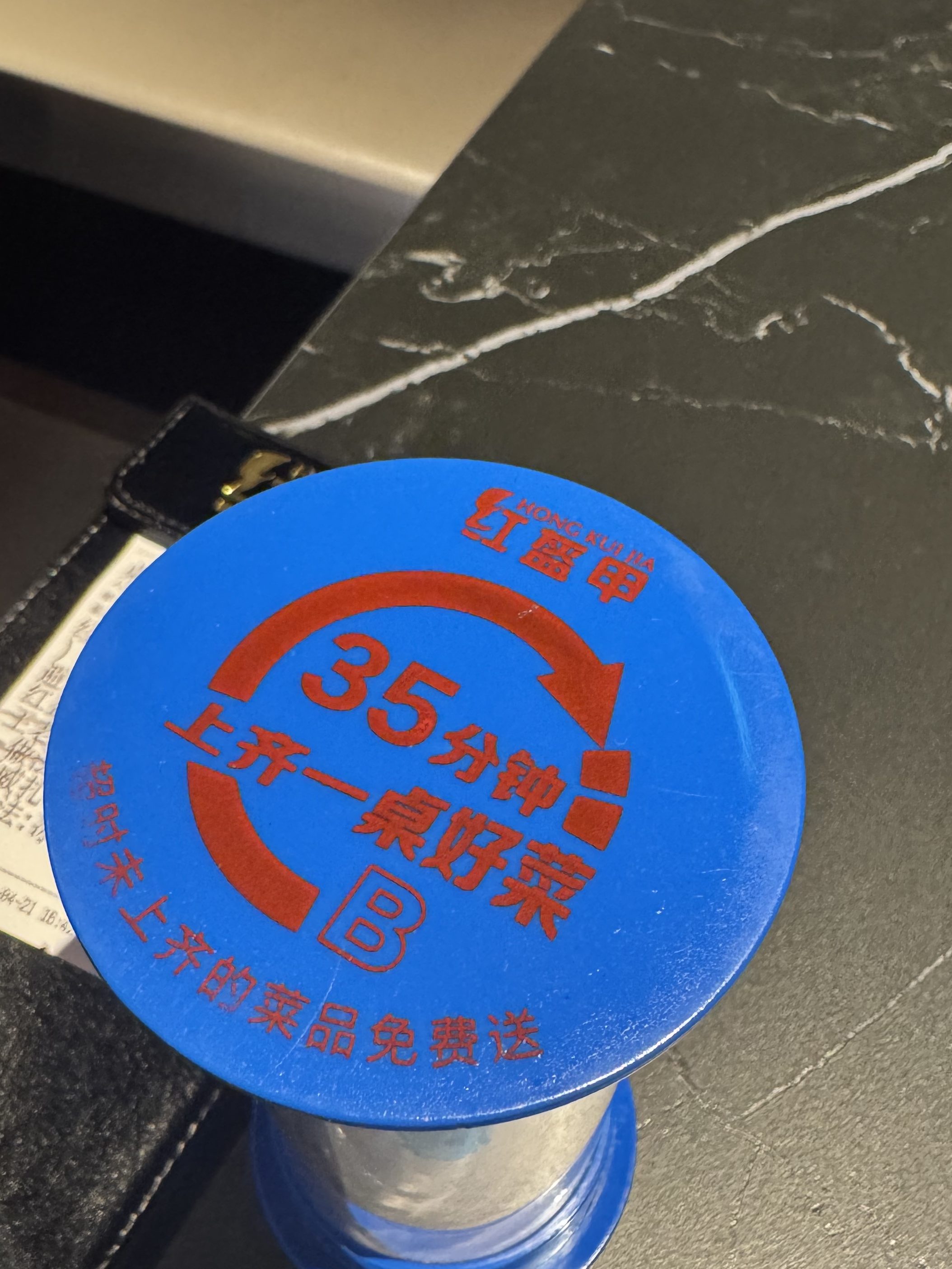
As you eagerly anticipate your crayfish, an hourglass appears. If the food isn’t out in thirty‑five minutes, it’s on us. You’re amused at the fact that they can make such commitments and stick to it. You wonder how many experiments and failed promises they would have gone through to arrive on 35. As your mind wanders off to think about their “default rates”, their signature má là lóng xiā (麻辣龙虾) is served. You debate for a few seconds on whether to peel the 30 or so stacked crayfish yourselves. Then j like the Superman, one of the server comes to rescue, introduces herself, and starts peeling gracefully.
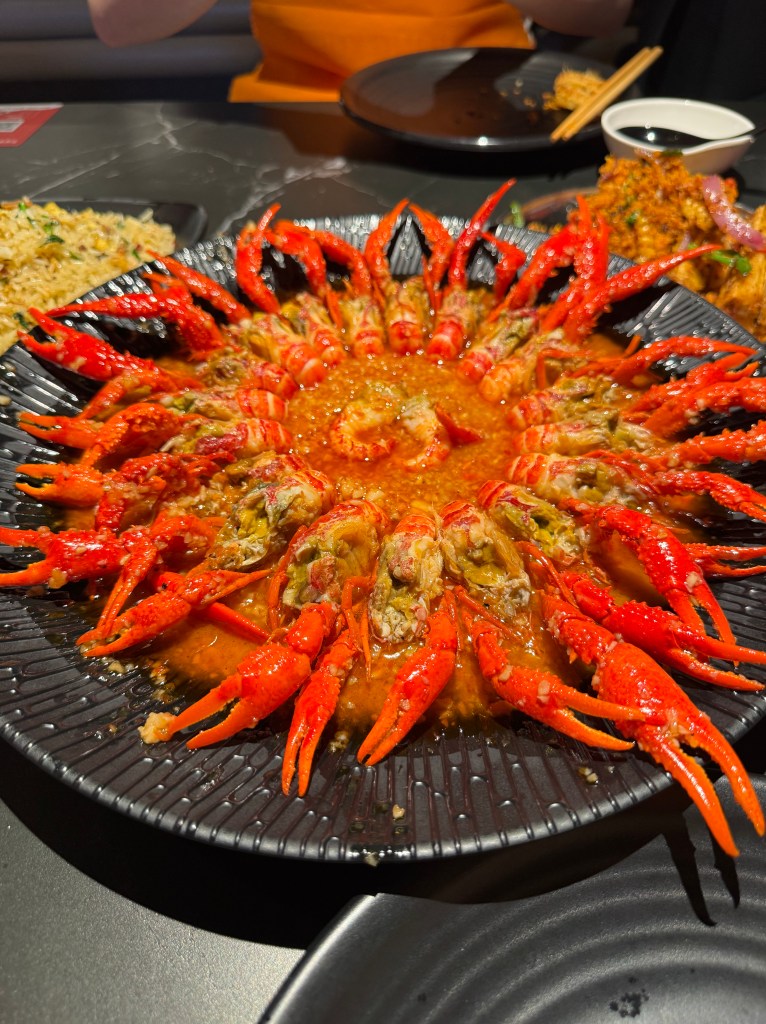
It’s beautiful because it’s so efficient and doesn’t allow any superfluous movements. For every crayfish, she takes no more than 5 seconds. Within about 2 minutes or so, you see a blossoming platter of peeled crayfish. You hesitate breaking it for a second, then with the similar pace as the peel, they end up inside your stomach.
Looking back, I immediately knew that I wanted to go back. They define your travels. Of course, they may not be for everyone. If you are looking for a quiet serene restaurants, HJYQ is not for you, or most popular everyday restaurants in Shanghai for that matter. You will have to constantly hear the automated voice blasting next number in the queue, not to mention the heat. Chaotic is an understatement.
I don’t see HJYQ or Red Armor as the future of casual dining, nor do I rank them above every other style. Countries shape service differently—Japan leans deferential, the U.S. relaxed—but these brands are carving a loud, fun lane that still puts thoughtfulness first. Flashy, yes, yet every gimmick is anchored in customer care.
For me, the biggest takeaway is that they don’t treat anything as static. You can imagine a new dine-out experience. Then they’ve artfully turned those new experiences into immensely successful businesses. Haidilao operates 122 outlets across 14 countries (excluding Chinese stores) 1and HJYQ has over 100 locations domestically2. Besides American franchises, I know very few that have gone globally that successfully.
It’s truly magical in that they’ve not only nailed building all the necessary physical operations for running successful restaurants, but also engrained customer-centric, playful culture into every employee. For someone obsessed with company‑building, there’s deep joy and beauty in seeing such well-greased machines.
One last thought: China’s day‑to‑day life is almost friction‑free and digital; you can glide through a week without speaking to a soul. Yet the restaurants drawing the longest lines are the ones doubling down on human connection. Maybe that’s exactly why they work.
Both HJYQ and Red Armor has many locations across Shanghai, but the ones I went are
- HYJQ @ Nanjing East No.1 Department Store (很久以前羊肉串 南京路第一百货店) : https://surl.amap.com/3CmXuje1lfsL (Yes, you need to use a Chinese map service, this one Amap from Alibaba)
- Red Armor @ People Square (红盔甲·小龙虾(人民广场店): https://surl.amap.com/1ADfJrb1u2uu
If you are planning to go to China, I recommend them as must-visit. As said, they defy your expectations and define your journeys. If you are feeling adventurous, there’s also another upcoming trendy restaurant that’s apparently very futuristic called 3 Warehouse (https://surl.amap.com/39h5ZYsm2iI) that I haven’t gone to.
Notes
- Haidilao made close to $800M revenue in 2024. Excluding non-restaurant revenue, 122 stores generated $758M, an average of $6.2M per store. As of May 5th, 2025, its market cap is $1.26B. Source: Company IR ↩︎
- No sources were available in English. Source: Baidu ↩︎


 Sang Ha Park
Leave a comment