Disclaimer: This is only a personal exercise and is not a financial advice. I’m in no way affiliated to any of the companies mentioned here.
Since this is a simulated exercise, I will focus much more on the product and market, and less on team, business model, and traction since I have no additional information other than what’s publicly available, which is very little. I’ll jump right into the company, which is all the more apt to be the first portfolio of the exercise given its “simulation” product.
Overview
Hash is an end-to-end platform for multi-agent modelling and simulation. Its uniqueness and competitive edge comes from its ultra-simplified experience for anyone to create a rich and complex simulation either by entirely developing it themselves or importing pre-defined libraries that are made by other users. In that it aims to become much more than a tool provider, but to become a platform and community of agent-based simulation and possibly any kind of simulation in the future.
Market – Agent-based Simulation
Agent-based simulation refers to a way of constructing simulation by setting deterministic behaviors to individual agents (can be any that can be isolated as a single entity like people, trees, and even molecules) and observing how those agents interact to generate a complex system. In that process, new properties or patterns would often emerge from accumulation of simple behaviors of agents. Hence it has become an extremely useful tool in predicting and understanding complex systems or processes that belie deterministic principles in a macro scale.
For instance, agent based simulation has been extensively applied in epidemiology, where it’s extremely difficult to model the spread of epidemics from a top-down approach, but relatively easier from a bottom-up approach of giving individual agents with certain pre-determined characteristics. The application has increased to business, organizational behavior, architecture, urban planning, disaster recovery, insurance, and even self-driving cars. Basically any phenomenon or system that are composed of smaller sub-systems can be modelled and simulated by agent-based simulations, which pretty much includes everything. I believe that as both observation and collection of any phenomenon / data improves, it would be much easier to pinpoint and abstract core behaviors required to sufficiently mimic the real interactions of agents in the real world (In turn because you can understand each agent’s behavior much better). Hence many more applications will be able to use agent simulation in the future. And simulation will be one of the main ways we understand the world as we rely more and more on quantitative data to better reflect and define our model of the world. In that process, simulation lies squarely in the middle as a generator of newer and possibly unseen data for both humans and machine and modeller of our continuously refined model of the world.
At the same time, thanks to Hash’s intuitive environment, libraries of behaviors, agents, and dataset (more to be discussed next), I believe that many many more people will ticker with agent based simulation. According to Hash, it has already garnered more than 7,500+ “hobbyists” in less than 3 months after their seed round announcement. While the Company has casually mentioned that an existing agent simulation software can easily charge more than $10K per user per year, I believe that potential significant market expansion from experts outside the currently applied fields, non-experts, hobbyists will be the key driver to the Company’s growth. In other words, the Company’s outsize potential will come from the mass. Such vision is affirmed by the Company several times in their website, most notably in “We believe we can overcome bounded rationality by making powerful simulation universally accessible to all”.
So the company is not only expanding the market horizontally (more fields), but also more importantly vertically (more users) as well.
Product
Currently Hash offers hCore, which is the in-browser simulation application, and hIndex, which is an open source library of behaviors, agents, dataset, and simulations created by community members. The Company plans to roll out hCloud, an automated allocation of computation to run the simulation, and release open source version of hCore’s engine, hEngine by the end of the year.
Let’s dig deeper into two available products first.
hCore
hCore is the in-browser simulation application. It’s an comprehensive simulation IDE with built-in visualization, Javascript & Python support, and integration to hIndex.
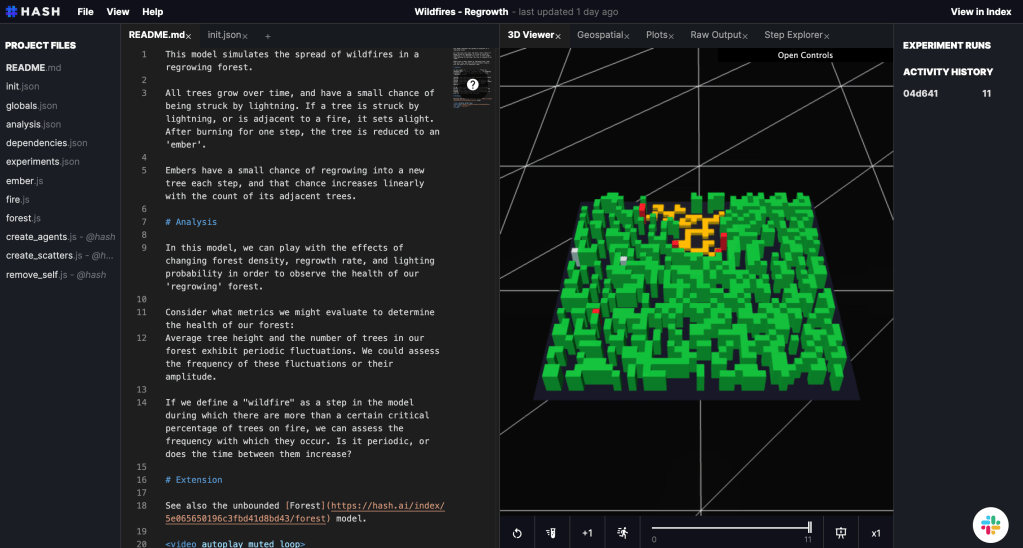
It’s extremely simple to a point that anyone with a Javascript or Python background can immediately create a simulation in less than 10 minutes following their docs.
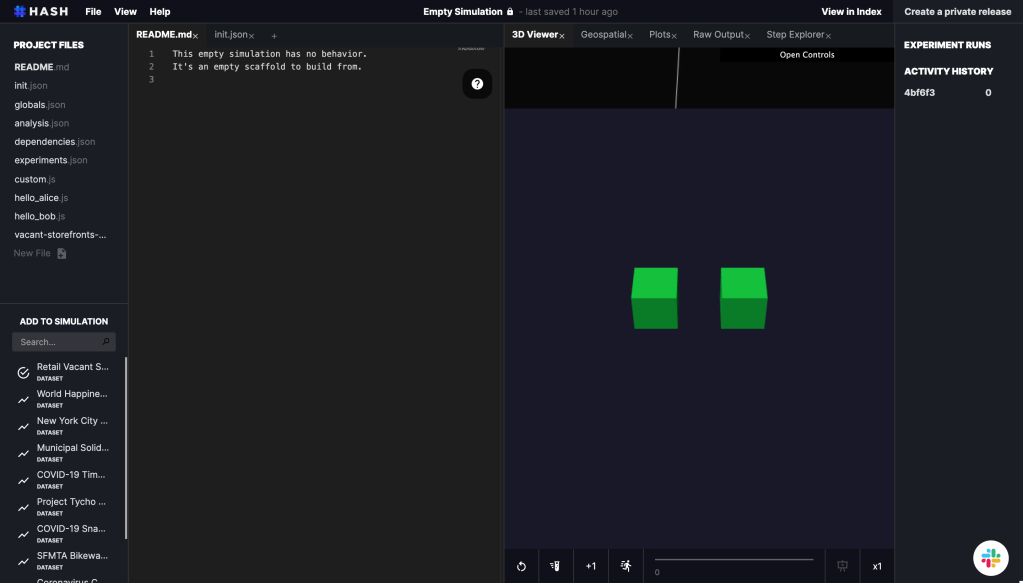
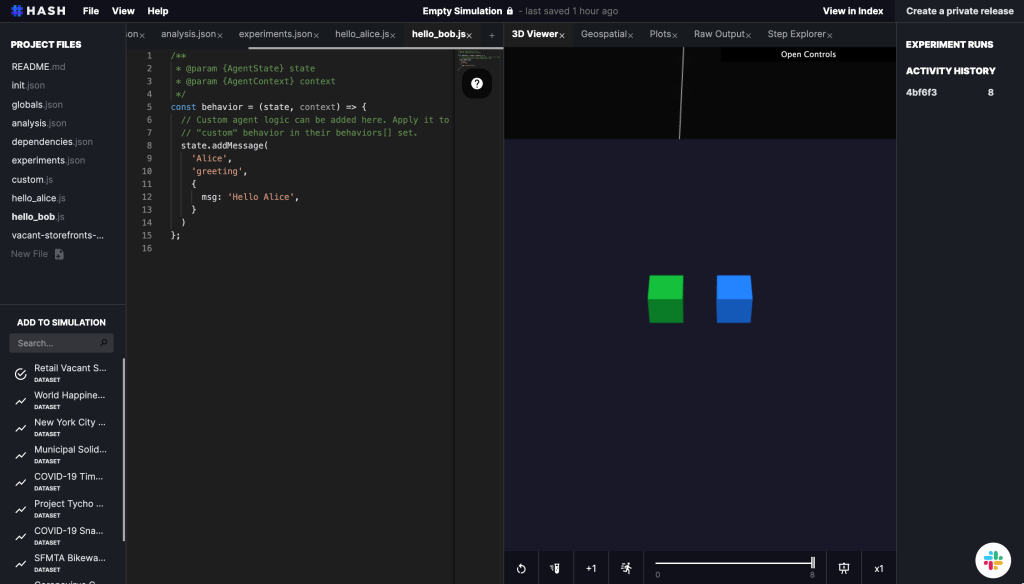
By far, Hash’s documents and tutorials were the easiest from any that I have seen. It’s simple, intuitive, and even fun. At the same time, its performance and capacity belies its simplicity. Based on my experiments, it can easily run with millions of agents with 10+ different identities interacting with no delay.
hIndex
hIndex is the community library of simulations, behaviors, or pure dataset that can be directly integrated to the simulation as a component or as a whole. The library is already showing promise as 174 simulations, 62 behaviors, and 102 dataset are already uploaded and shared for free as of Oct 19th.
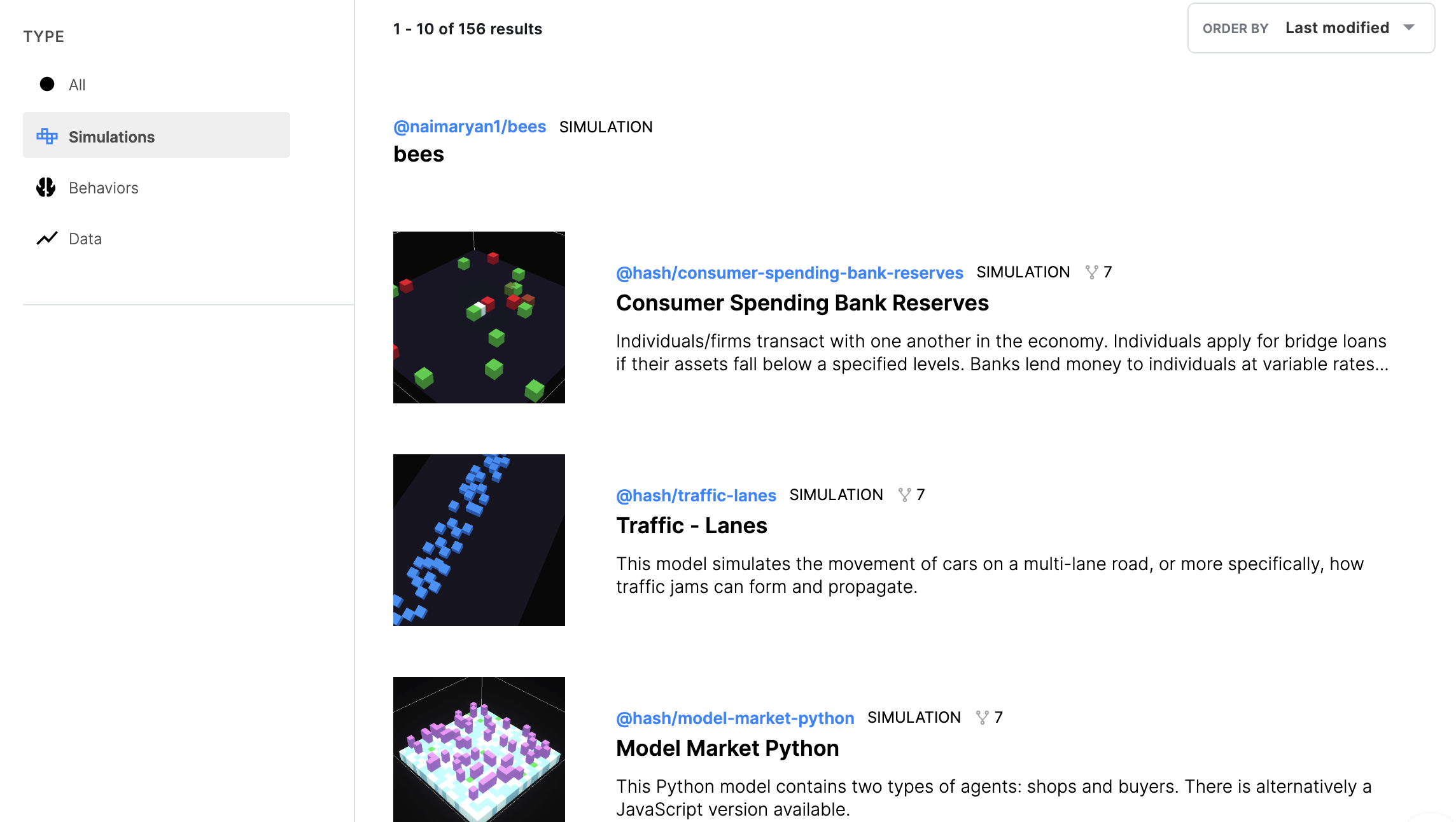
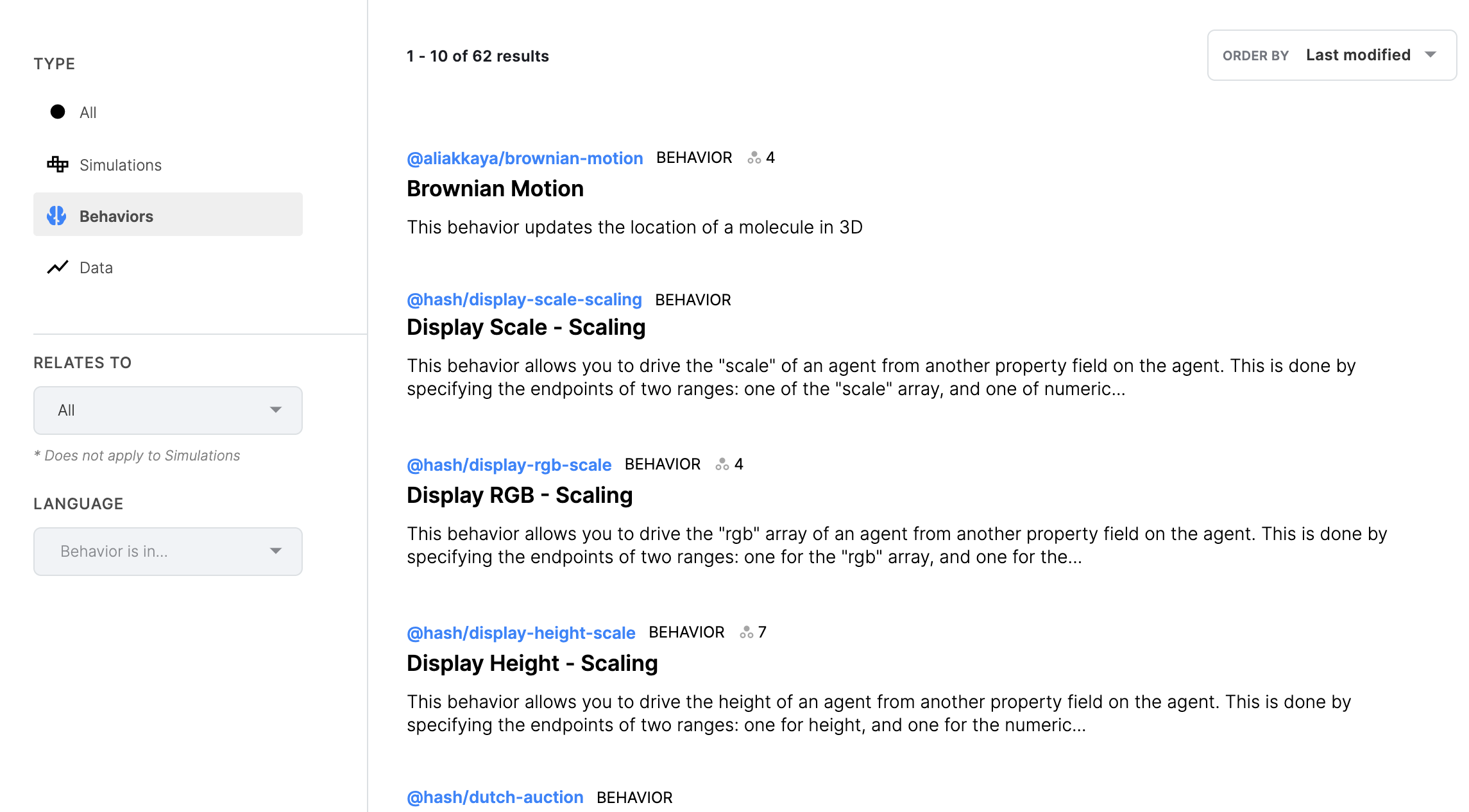
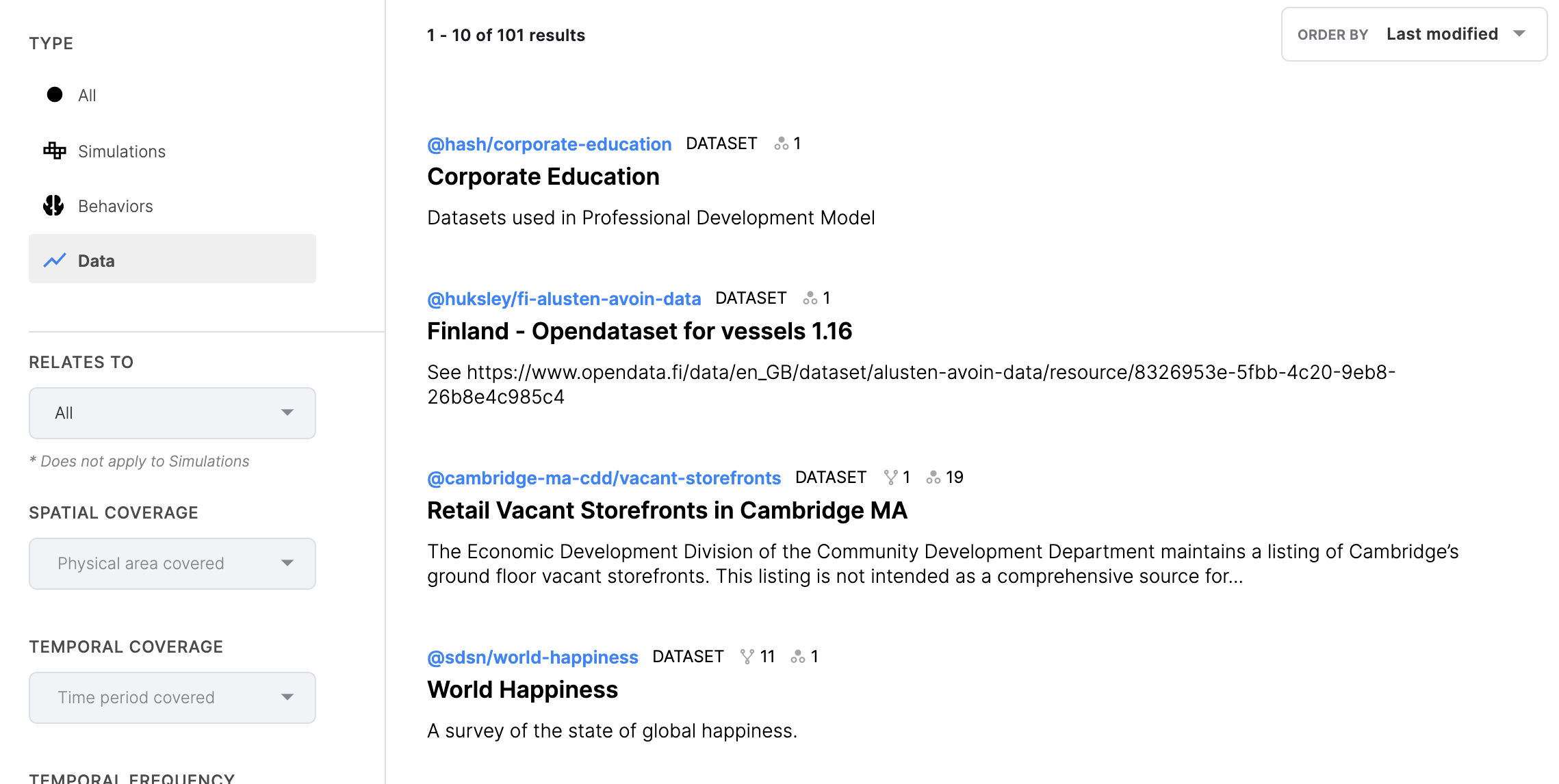
Note how already users have a rich ecosystem of components that they can cherry-pick from either the behaviors or by going through simulations and teasing out what they want. For instance, I can start my simulation by populating 1000 agents and importing Brownian motion with almost no effort, which in a typical simulation software would have taken hours just to set up and run. Such network of resources will become even more powerful as it grows and will create a virtuous loop where creating a simulation becomes easier and more simulations and behaviors are shared.
Already by hIndex, Hash can be compared to early days of Kaggle which hosted dataset, competitions, and a community for machine learning globally. But by providing its own engines, development environment, and immediately accessible resources, it has the potential to be much bigger in the simulation space.
The beauty of hCore and its tightly coupled hIndex is that it radically democratizes agent-based simulation to anyone while creating a beautiful and efficient experience. In that process, they’ve empowered any users to solely focus on creativity, while providing battle-tested modular components and the platform to do so.
hCloud & hEngine & Roadmap
hCloud
hCloud (public beta) automatically optimizes computing resources to fit your simulation’s needs. Simple simulation doesn’t require any utilization of cloud resources. But as simulation gets complex and bigger, say you increase the number of agent to a few billions or make their behaviors much more complex, the need for cloud will be clear. In my opinion, this can be the single biggest value-add for experts, enterprises, research institutions and hard-core hobbyists that are tickering with Hash on the borderlines.
hEngine
hEngine (Q4 2020) is the engine that runs the simulations in Hash. While the engine could be hidden and locked to the application, Hash team has decided to open-source it, making it accessible to anyone. So even if you are not running the simulations on hCloud or Hash, you can use their engines to run simulations freely on your own. Hash team believes that this will create a free alternative to existing users of AnyLogic, FlexSim, and Simio. If hEngine can provide comparable performance to competitors, such openness will be a significant value-add to customers because they don’t have to experience any cost or inefficiencies from lock-in effects (such as being tied to one software and locked inside a proprietary system) and truly focus on choosing a service that they need. To 3rd party developers, this will create another opportunity to build off secondary applications on top, paving the way for Hash to be the go-to platform for simulations.
In a grand scheme, I believe that Hash’s plan would be to commoditize the engine by making it free, attract and existing users from walled softwares, and create an “open ecosystem” where other value-add services including the 3rd parties can be integrated (But Hash’s libraries will have better integration no doubt). Think Android.
I also believe that there’s no better attestation of their confidence in their technology.
Roadmap
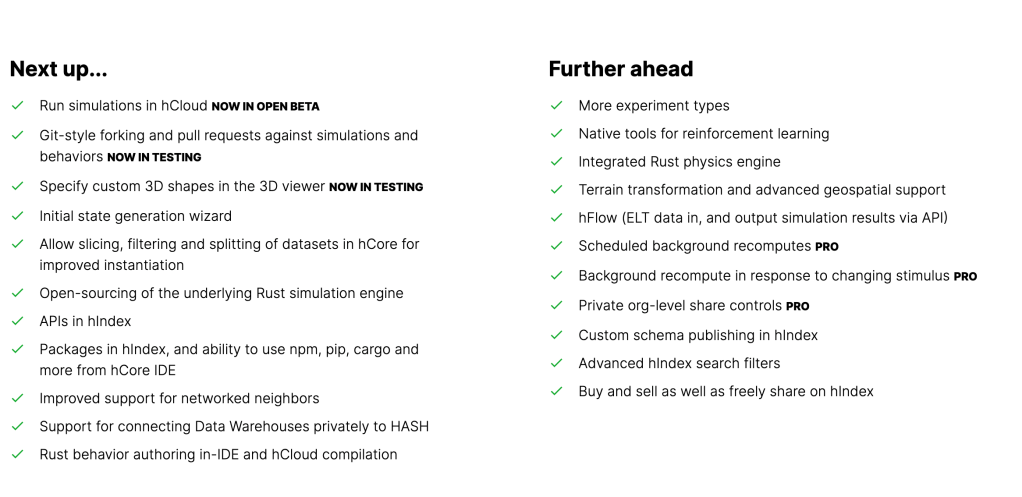
As can be seen, the team is extremely detailed and clear in terms of their product development. Its plan is singular, make complex simulation easier to develop, deploy, compute, and share.
Business Model
Though not much has been discussed how they plan to make money, based on crumbs that they’ve left behind, we can reasonably assume that
1) They will charge for compute resources 2) Based on “Pro” label in the Roadmap, offer tier based subscriptions (like individual, institutions, and enterprises) based on number of users and features (which according to the Company can be as much as $10K per user for their competitors), and 3) Sell special libraries, value-add services, and basically any advanced development resources.
The Company can be very profitable with the above mentioned 3 revenue streams, which have gross margins. However all 3 doesn’t seem to promise explosive growth because the current market itself is very small.
But Hash is the company that is expanding and re-defining its market by making simulation possible for everyone. It’s not hard to imagine that Hash becomes synonymous with simulation itself as Google became synonymous with searching. Because it’s so niche, it can dominate and become a household name.
Risks
I won’t talk about internal risks since I don’t have an inside view. The biggest external risk comes from the fact that despite the team’s effort, that simulation will ultimately remain a niche market. That is why I believe that the team will eventually have to be an evangelist as well and make sure that simulation enters the collective imagination as machine learning did. Sooner or later, perhaps after the next raise, the team will need to constantly create and push out interesting contents that reflect the reality and predict the future. Just providing good environment and tools won’t be enough in my opinion. Ultimately simulation must find its clear “utility” and let it be known to the world as much as machine learning did so seamlessly, clearly, and viscerally. But if the Company can do be part of that simulation’s journey to the mainstream, I think the Company can be the “Netscape” of simulations.
Exit
Though it is too early to discuss what exit would look like, I would say the Company’s true value will not come from its revenues, but from its number of users, reach, and amassed collective information that has been contributed by users along with its robust infrastructure. Immediate peer would be Kaggle, which despite its brand, was far from a good exit according to this Hacker News comment ($25m valuation at 2011 and ~$12M exit at 2017) because it essentially had no business besides collecting people’s vague interests.
Hash is miles away from Kaggle because it owns the end-to-end value chain of simulation.
The more relevant and ambitious peer in my opinion is Unity which provides engine for game developers and went public in September. It’s currently valued little over $24B. Though farfetched and differences in industries are clear, I think the Company actually serves a bigger role in the space. As said, because the space itself is small and early. But even Unity started in 2004, way before mobile phones became powerful enough devices for any games.
Team & Investors
Considering the Company’s product, vision, and its ambition to own and create a space in a new and open way, it’s not hard to expect stellar angel investors that had led similar ventures in the past to notice. Most notably Stack Overflow founder Joel Spolsky and Kaggle founder Anthony Goldbloom have joined the round where the former also became the chairman.
Basic information
The Company raised $2.5M in Jun 2020 for its seed round and has 17 employees including their investors. Considering normal seed round dilutes around 20 ~ 30%, the company’s post round valuation would sit somewhere between $8M ~ $12M roughly speaking.
Summary
Hash provides end-to-end solutions for multi-agent simulations and aims to be the dominant platform by creating an open source community. Considering the space and Company’s early stage, if the Company can evangelize simulations and be at the forefront of the riding industry, it has the potential to become a household name, synonymous with simulations. Of course, with huge financial upside. Its products are becoming ready and the questions is the industry ready?
I highly recommend anyone reading this to try out the product! It’s simply amazing.

 Sang Ha Park
Leave a comment